You ask three different builders for a quote on a custom pool and receive three completely different numbers. One is suspiciously low, one is middle of the road, and one seems astronomical. This is the standard experience for homeowners in Seguin, New Braunfels, and across the Hill Country.
The frustration comes from the fact that most builders avoid giving a straight answer. They say it depends on the design. While that is true, you still need a baseline to budget your project.
Why "It Depends" Is the Only Honest Answer
If a builder gives you a flat price before seeing your backyard and reviewing your site plan, they are guessing. A gunite pool is not a pre-fabricated product dropped into a hole. It is a custom engineering project built into your specific piece of land.
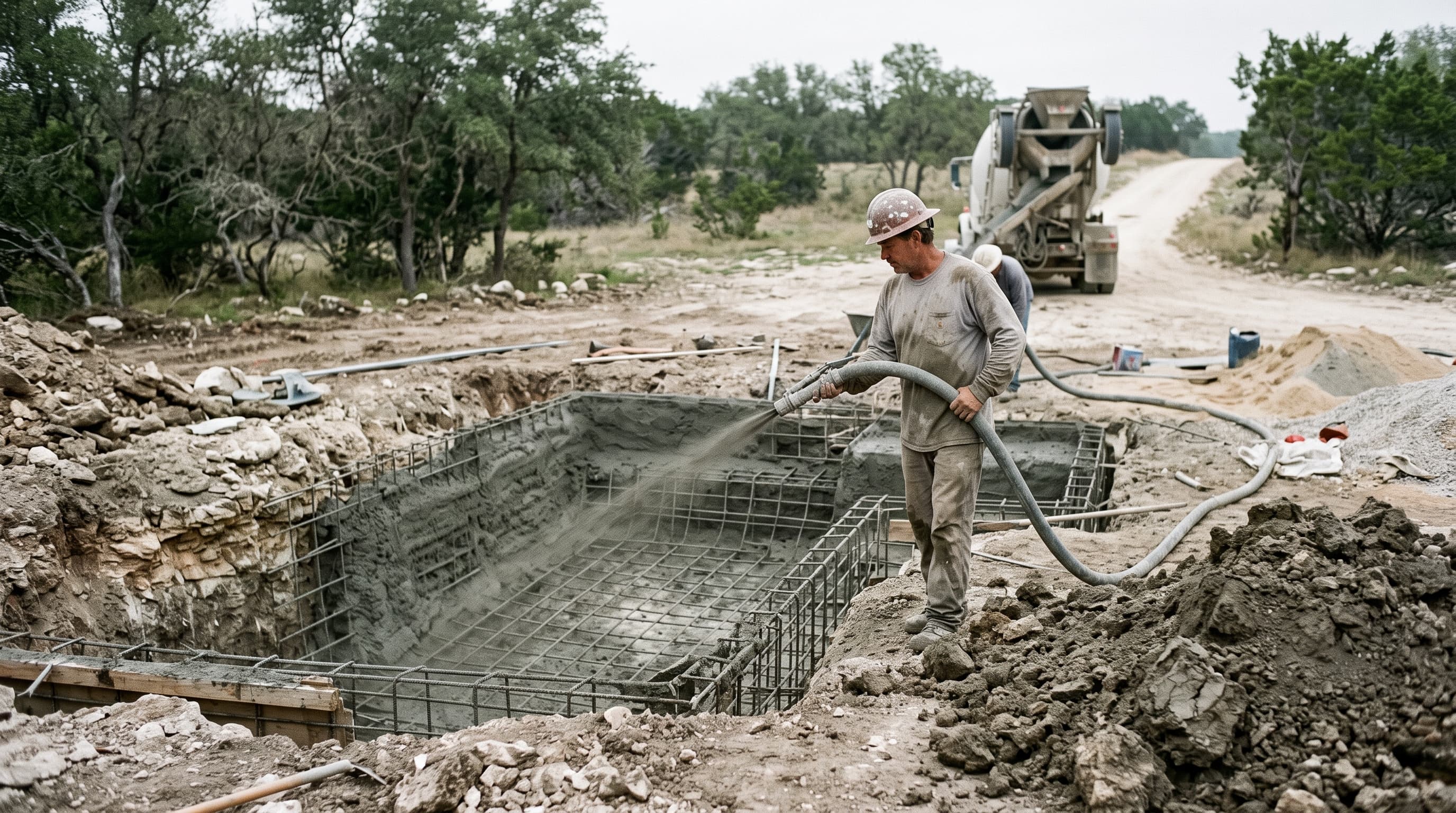
In the Texas Hill Country, the ground varies wildly from one lot to the next. You might have soft loam in one backyard and solid limestone bedrock three houses down. The cost to excavate through rock requires different equipment and more time than digging through soil. If a builder doesn't account for your specific soil conditions, that "fixed price" will change the moment the excavator hits a rock ledge.
The same applies to the slope of your land. A flat lot in Seguin is straightforward. A sloped lot in New Braunfels requires retaining walls or a tiered deck to keep the pool from sliding or leaving you with a massive, unusable dirt cliff behind the water. These structural necessities are part of the gunite pool cost but vary based on your topography.
The Primary Drivers of Your Project Cost
When we break down a quote, the price is driven by five main factors.
Size and Depth
The larger the footprint, the more materials and labor are required. However, depth also plays a role. A shallow lounging pool uses less concrete and steel than a deep-end pool designed for diving. Every extra foot of depth increases the volume of gunite needed and the amount of time spent on reinforcement.
Site Conditions and Excavation
This is where Hill Country projects often diverge. If we encounter heavy rock, we have to use hammers or blasting to clear the hole. This adds significant labor and equipment costs. Drainage is another hidden driver. In areas with heavy clay or steep slopes, we must install professional drainage systems to ensure rainwater does not wash out your decking or seep into the pool shell.
Finishes and Interior Surfaces
Standard white plaster is the baseline. However, most homeowners today opt for pebble finishes or polished quartz. These materials are more durable and resist staining better than basic plaster, but they cost more per square foot. The choice of tile for the waterline also affects the final number, ranging from standard ceramic to high-end glass mosaics.
Equipment and Automation
The "guts" of your pool dictate both the upfront cost and the long-term energy bill. A basic pump and filter are cheaper, but variable-speed pumps and salt-water chlorine generators save money over time. Adding automation—the ability to turn on the heater or lights from a smartphone—adds to the initial investment but changes how you use the pool.
Decking and Landscaping
The pool is only half the project. The surrounding deck (travertine, stamped concrete, or pavers) often accounts for a significant portion of the budget. A 10-foot perimeter of travertine costs substantially more than basic concrete. If you want integrated tanning ledges, fire pits, or outdoor kitchens, these are additive costs that move the project into a higher price bracket.
Local Market Pricing: What to Expect
In the Seguin, New Braunfels, and San Antonio market, high-end custom gunite pools typically land between $85,000 and $250,000.
A project at the lower end of that range ($85,000 to $120,000) is usually a clean, rectangular or geometric pool with standard finishes, basic equipment, and minimal decking on a flat lot. These are quality builds, but they lack the complex architectural features of a luxury estate pool.
Projects that climb toward $250,000 and beyond typically involve: (1) Large footprints with custom freeform shapes. (2) Complex site work involving significant rock removal or massive retaining walls. (3) Premium finishes like full pebble interiors and glass tile. (4) Advanced features such as infinity edges, swim-up bars, or integrated spas. (5) Extensive hardscaping including large travertine patios and outdoor living structures.
When you see a quote for $40,000 or $60,000 for a "custom gunite pool," proceed with caution. In the current Texas market, those numbers rarely cover a complete, turnkey project.
Identifying the Lowball Quote
A suspiciously low quote is often a "shell-only" price. The builder gives you a number that covers the hole and the concrete but leaves out the critical details that make a pool functional and legal.
Check your quote for these common omissions: (1) Permits and Engineering: Local municipalities in Guadalupe and Comal counties have specific requirements. If permits aren't listed, you will be paying for them later. (2) Electrical Work: Running power to the equipment pad often requires a licensed electrician and new trenching. Low quotes frequently leave this as "owner's responsibility." (3) Water Fill: Filling a 20,000-gallon pool isn't free. Some builders include the water haul; others do not. (4) Final Decking: The quote might cover the pool shell but leave the surrounding patio as an optional add-on. (5) Drainage and Grading: This is the most common omission. A builder who doesn't plan for where the water goes after a Texas thunderstorm is leaving you with a future landslide or a flooded yard.
If a quote seems too good to be true, it usually means the builder is planning to hit you with change orders once the project has started and you are too committed to switch contractors.
How to Compare Quotes Apples-to-Apples
To find the real gunite pool cost, you cannot simply compare the bottom line of three different proposals. You must compare the line items.
Ask every builder for a detailed scope of work. If they give you a one-page estimate with a single lump sum, ask them to break it down. Compare these specific areas:
The Shell: Is it standard gunite or a reinforced structural slab? What is the thickness of the walls and floor? The Finish: Is it basic plaster, quartz, or pebble? Get the brand name of the finish. The Equipment: Are they quoting a single-speed pump (outdated) or a variable-speed pump (modern)? Is the heater gas or electric? The Site Work: Does the quote include rock excavation? If so, is it a flat fee or an hourly rate for "rock encountered"? The Decking: Exactly how many square feet of decking are included, and what is the material?
When you align these details, the price difference usually makes sense. The "expensive" builder is often just quoting the things that actually need to be done, while the "cheap" builder is quoting a best-case scenario that rarely exists in the Hill Country.
What to Do Next
If you are budgeting for a pool, do not start with the price. Start with the site and the vision.
(1) Walk your property and note any steep slopes or areas where you know there is rock. (2) Decide on your "must-haves" (e.g., a tanning ledge or a salt system) versus your "nice-to-haves." (3) Gather your site survey or plot plan to show the builder exactly where the pool will sit. (4) Ask for a portfolio of completed projects in your specific town to see how they handle local soil and drainage.
Building a custom pool is one of the largest investments you can make in your home. The goal isn't to find the lowest price, but to find the most honest price. A project that starts with transparency ends with a backyard that lasts for decades.
If you want a realistic look at what it will take to build a gunite pool on your property, we are happy to walk through the specifics with you. Reach out to Turner Custom Pools and let's talk about your land.