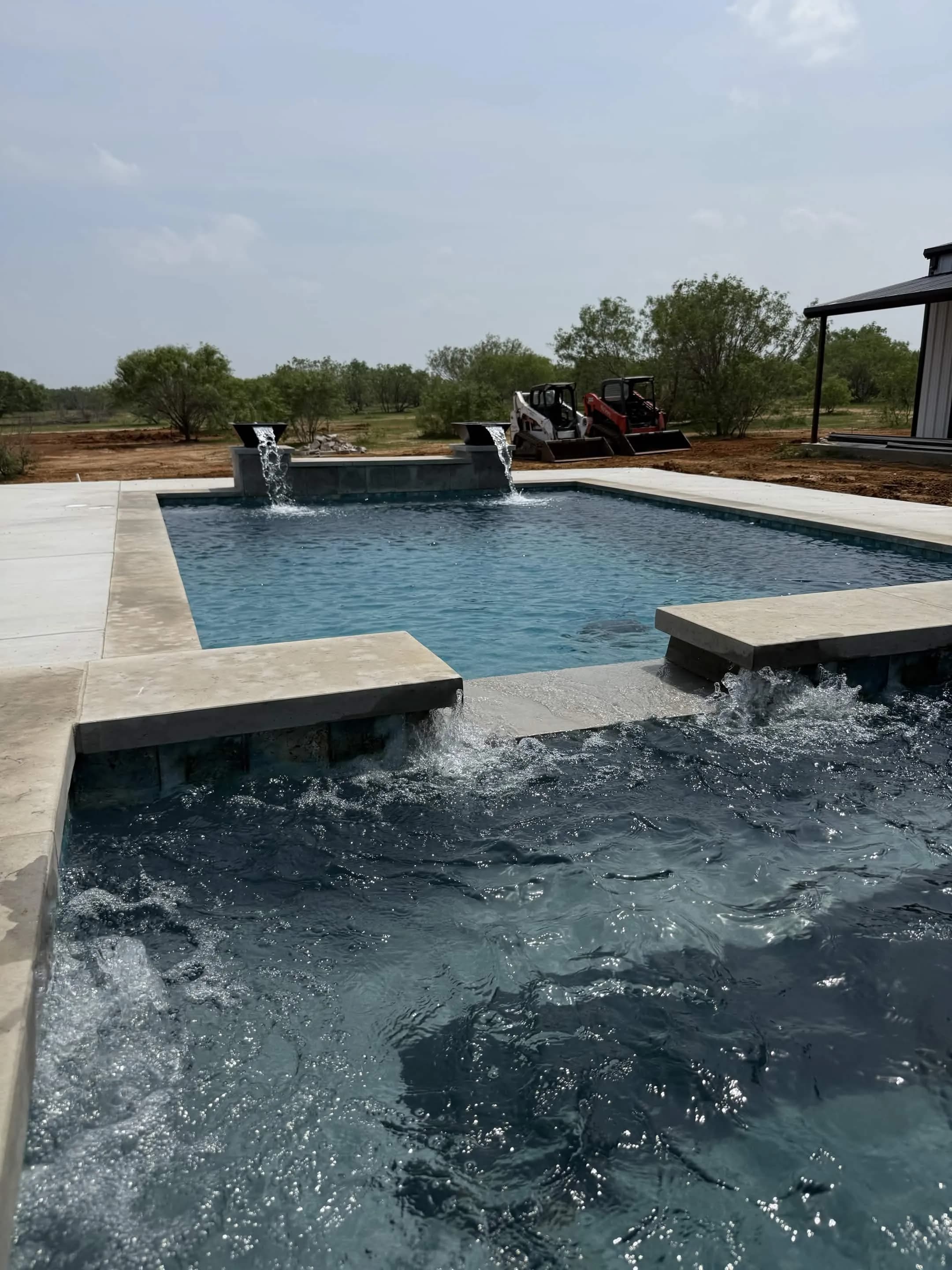
Gunite Pool Construction
Custom Gunite Pools Built for Hill Country Soil
Gunite is sprayed concrete poured over a steel-reinforced framework. It’s the same building method used for foundations, retaining walls, and everything that needs to hold up under real Texas conditions. I build pools the same way I build homes: with structural integrity as the starting point, not an afterthought. That matters more in Hill Country than almost anywhere else in the country.
Why Gunite for Hill Country Dirt
Limestone, Caliche, and Ground That Moves
Hill Country soil is not a flat plane you dig straight through. You hit rock — limestone and caliche — before you get where the pool actually goes. Then there’s the seasonal movement: ground dries and cracks in August, swells back in October.
Fiberglass pools are manufactured in a mold. They have a fixed shape and a fixed structural response. They don’t flex with the ground. In Hill Country terms, they crack.
Gunite is different. The steel rebar framework is shaped by hand to match your exact yard. The concrete is sprayed on wet and packed tight against the earth. It bonds to the soil around it, and moves with the ground.
I’ve seen fiberglass pools crack after their second or third Texas summer on a Hill Country lot. I have not seen a well-built gunite pool do the same.
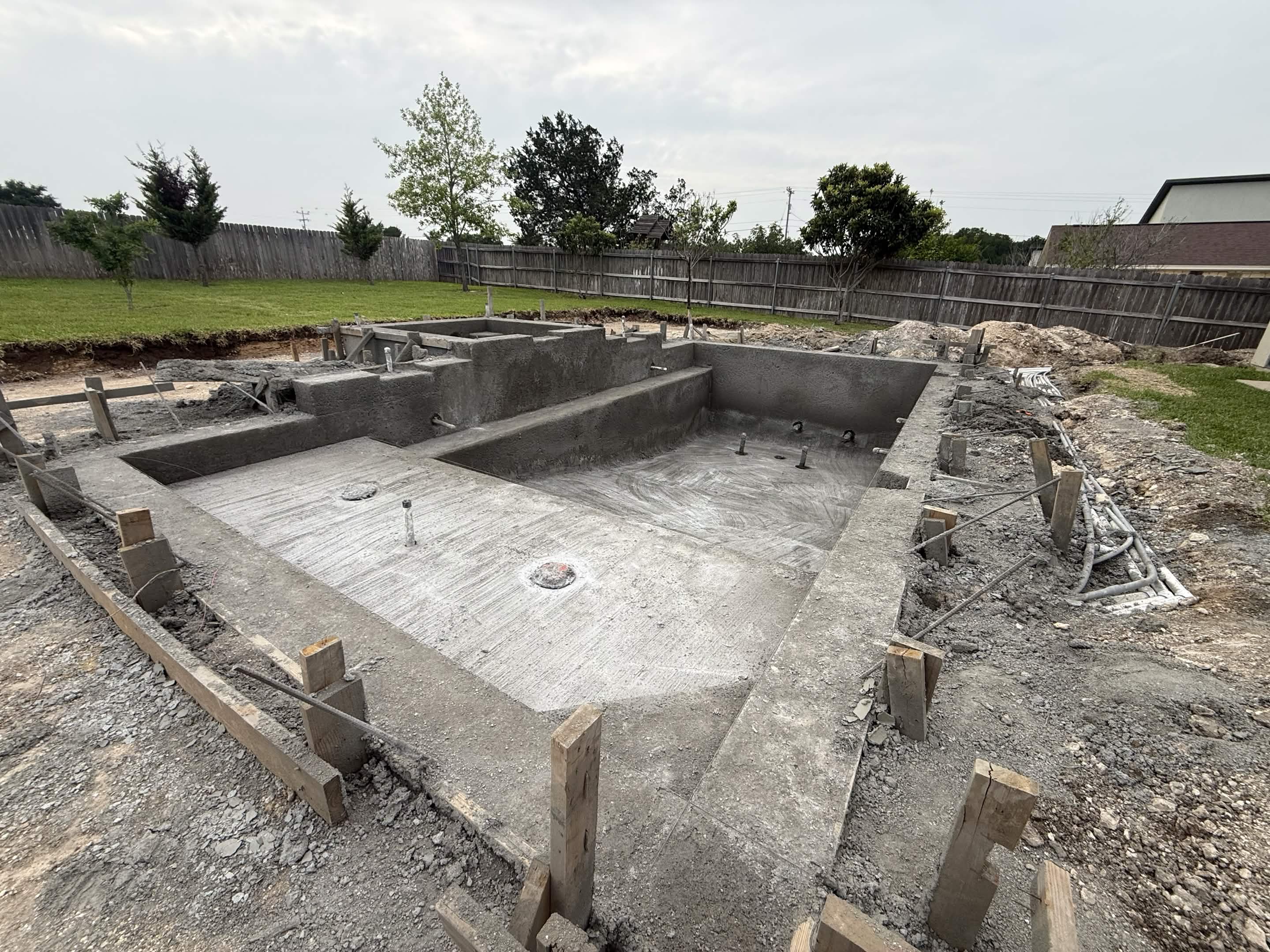
Gunite shell just after spraying — one continuous pour, no cold joints
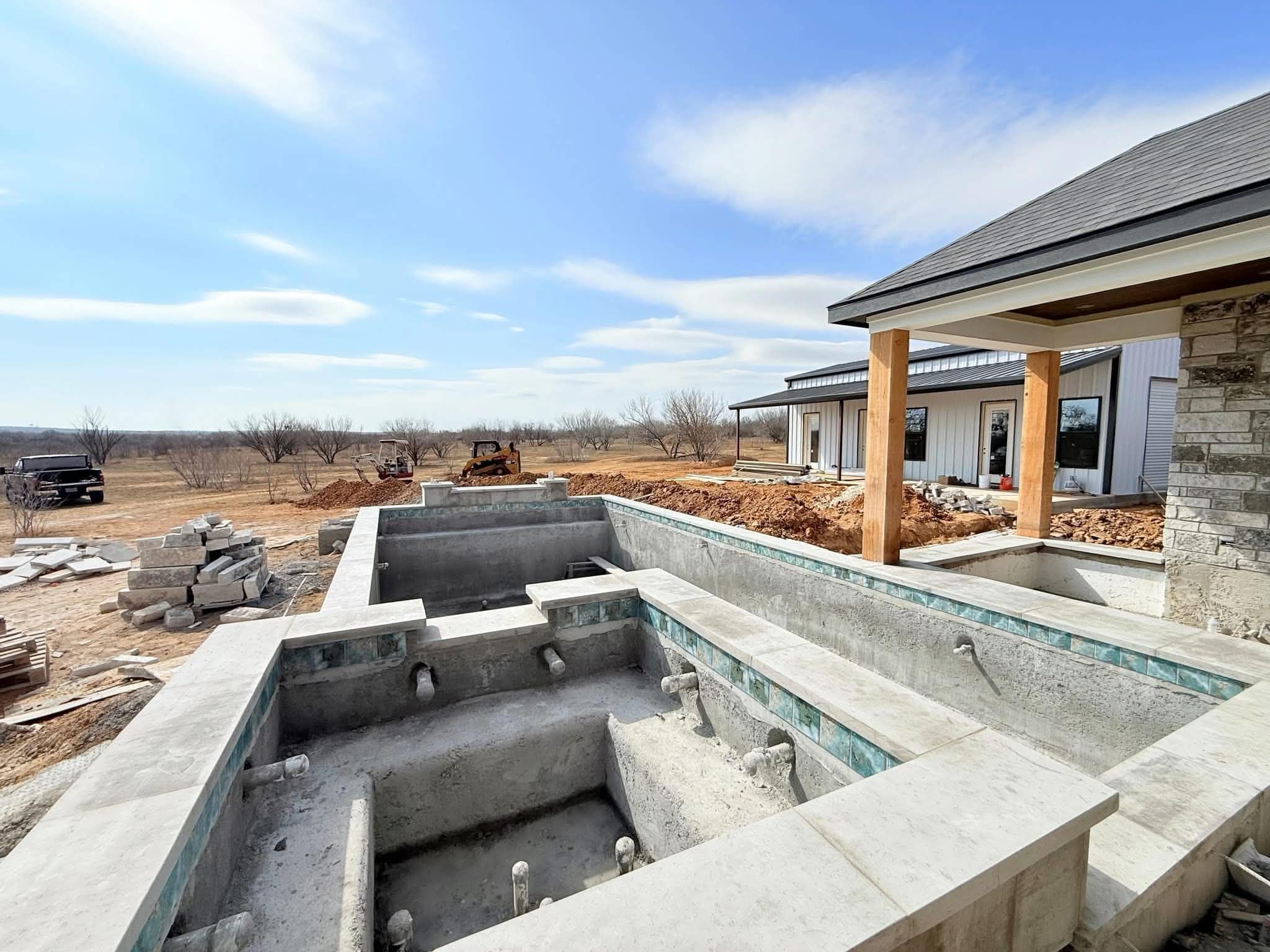
Tile and coping going in — every piece set by hand
Thicker Shells. Smarter Reinforcement.
Where a fiberglass installer might apply a standard gelcoat thickness, I apply what the condition demands. Thicker shells in areas where soil pressure is highest. Double-mat rebar in zones where the ground is most prone to shifting. Smarter plumbing runs that account for freeze cycles even though they rarely freeze down here — because a burst pipe is still a burst pipe after 20 years.
This is what 15 years of custom home building teaches you. You don’t use the same foundation for a house on flat ground as you do on a hillside lot. Your pool deserves the same thinking.
One Perfect Pour
Gunite is shot onto the rebar framework in a single continuous pour. That means there are fewer cold joints, fewer weak points, and a monolithic shell that holds together as a single structural unit.
Fiberglass goes in via a crane and a mold. It’s uniform because the mold is uniform. Gunite is custom — designed for your soil, your slope, your features, your family. There’s no mold limitation.
Unlimited Design Freedom
What You Can Design with Gunite
Gunite gives me unlimited design freedom because there’s no factory mold limiting the shape. Here’s what that means for your backyard:
Freeform Pools
Natural, organic shapes that follow the contours of your landscape. Think curves, irregular edges, integrated rock features.
Geometric Pools
Clean lines, rectangular, L-shaped, roman. If you want something sharp and precise, gunite nails it.
Slope Pool Builds
Raised pools, multi-level designs, pools designed specifically for hillside lots. This is where gunite shines.
Baja Shelves
A shallow ledge for sitting in the pool. Great for kids. Great for floating and watching the sky.
Infinity Edges
The edge that disappears into a catch basin, creating the illusion of water stretching out. Works beautifully on sloped lots.
Integrated Spas
The spa built as part of the same gunite pour. No seam between the pool and the spa where water can leak out.
Pool Features
Common Gunite Pool Features
Every gunite pool I build includes the base package: excavation, steel, plumbing, electrical, shotcrete application, decking, coping, tile, equipment, and startup. Beyond that, here are features you’ll commonly pair with your gunite pool:
Integrated Spas
Built as part of the same gunite pour. No seam, no leaks.
Water Features
Rock falls, sheet falls, bubble barrels — living water that sounds like Texas.
Fire Features
Fire bowls and pits that extend your backyard into cooler months.
Automation
Lighting, heating, and equipment controlled from your phone.
An Honest Comparison
Gunite vs. Fiberglass
Fiberglass isn’t a scam — it’s a real product with real advantages, and for some yards it’s the sensible choice. Here are the tradeoffs, laid out straight.
Fiberglass
A factory-molded shell, delivered by truck and set by crane.
Where it wins
- Faster install — the shell arrives finished
- Lower upfront cost than gunite
- Smooth factory gelcoat finish
The tradeoffs
- Fixed catalog shapes — the mold decides, not your yard
- Less forgiving of Guadalupe County soil movement
- Can’t be reshaped or resurfaced the way concrete can
Gunite
Concrete sprayed over steel rebar, shaped by hand on your lot.
Where it wins
- Fully custom — any shape, depth, or feature your yard calls for
- Decades of life, engineered for ground that moves
- Resurfaceable and re-tileable across its whole life
- Handles slope, rock, and raised designs fiberglass can’t
The tradeoffs
- Costs more upfront
- Takes longer to build — about 8 weeks here, not days
The short version: fiberglass is a fine pool on the right ground. On the ground we build on, gunite is the structure I can stand behind for decades — and it’s worth the extra cost and time if you’re building a backyard you plan to keep forever.
Honest Pricing
Gunite Pool Cost in Seguin
Here’s the honest range: most of the pools I build land between $85,000 and $250,000+. That’s wide on purpose. A gunite pool on a flat Seguin lot with easy access sits at the low end. A hillside build with rock excavation, an integrated spa, and travertine decking climbs from there.
What moves the number:
- Lot conditions — rock, slope, access difficulty
- Size and depth
- Features — spa, waterfalls, Baja shelf, lighting
- Decking material — concrete, flagstone, stamped, travertine
- Equipment — heating, automation, filtration upgrades
A word about suspiciously low quotes. If a bid comes in well under everyone else’s, something is usually missing: excavation contingencies for rock, the real decking square footage, the quality tier of the equipment, or the startup chemicals and orientation at the end. That number doesn’t stay low — it grows mid-build, one change order at a time. A real number early beats a teaser number that climbs once the excavator hits caliche.
Every quote is custom after the backyard conversation. I’ll walk the lot with you, understand the conditions, and give you a number that reflects all of it — not a starting price that balloons once excavation starts.
Get a real range for your yard in two minutesGunite Pool Answers
FAQ — Gunite Pools
What exactly is gunite?+
Gunite is a method of applying concrete. Steel rebar is tied into a shape, then concrete is pneumatically sprayed onto it at high pressure. The result is a dense, strong, monolithic shell. It's how you build foundations, retaining walls, tunnels, and yes — pools.
Is gunite the same as shotcrete?+
Close cousins. Shotcrete is the industry term for the whole family: concrete shot through a hose at high pressure. Gunite is the dry-mix version — dry material travels through the hose and water is added at the nozzle. Some crews use wet-mix instead. Applied right, both produce the same monolithic shell. What matters is the crew, the mix, and the steel underneath, not the label.
How does gunite compare to fiberglass?+
Fiberglass is a factory mold, lifted by crane and set into a dug hole. It's faster to install but limited in shape, thinner structurally, and doesn't flex well with shifting soil. Gunite is custom-shaped, thicker, built with rebar, and moves with the ground. In Hill Country, gunite is the better structural choice.
How long does a gunite pool take to build?+
About 8 weeks from design lock to water in the pool. The gunite application itself happens in a day or two. The rest is prep work — excavation, steel, plumbing, electrical, curing, decking, tile, equipment, and finishing.
Is gunite more expensive than fiberglass?+
Initially, yes — but it lasts longer and doesn't need replacement. Think of it the same way you'd think about stick-built vs manufactured housing. One is cheaper upfront. The other has held up for decades.
Can you repair or resurface a gunite pool?+
Absolutely. Gunite pools can be resurfaced, retiled, or reconfigured throughout their life — something fiberglass pools can't do. That's part of why they're 30+ year structures.
Ready to Build?
Talk to Coy About
Your Gunite Pool.
Tell me about your yard — the square footage, the slope, the rock, the view — and I’ll tell you what kind of pool would work best and what the process looks like.
Send the details
Let’s talk about your pool.
Free consultation. No obligation. Just a conversation about your yard.